
Sustainable Farming
Metrics to feed 10bn people

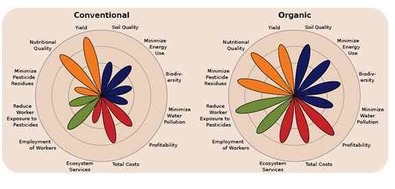
A great article in the guardian on the potential of sustainable farming explains nicely why it is a matter of metrics to incentivize decisions that make sense in the long run.
Thanks to the source for the picture
The US National Academy of Sciences defined four metrics of sustainability. According to that, sustainable agriculture needs to be productive, economically profitable, environmentally sound, and socially just. John Reganold, a professor at Washington State University, found that organic farming produces greater economic profits and less ecological impact. Conventional agriculture on the other hand focuses mainly on increasing yields, while not accounting for the other metrics appropriately. Reganold calls for public policies and private investments to transition more farmers into organic farming, or at least a hybrid model of organic, integrated, and conventional farming.
While people think tax money first when they hear new policies, I would argue that promoting the appropriate metrics should be the first step. Without the right metrics, any tax money or investment will be inefficiently allocated and, in the worst case, counteract its intentions. Rather than introducing new sources of money to be disbursed, we should review how we support farmers today. Most farmers in Europe are subsidized in one way or the other (take milk subsidies in Switzerland or sugar beet subsidies in Europe). Why not tying such subsidies closer to sustainable production metrics?
I am not advocating more rules and regulations, those won't be needed if you get the metrics right. Institutions are supposed to step in when efficient markets fail in considering important and socially desirable factors. As efficient markets have a one-dimensional metric, money, the introduction of more dimensions needs to come from other institutions.
_____________________________________________
Please share your comments and inputs (via comment function, twitter, e-mail, etc.). In my short write-ups I address topics that I am particularly interested in because they align with my values and beliefs. As such, they are always a reflection of my ideas, thoughts, and opinions. The only thing I am positive in that regard is that I do not have all the perspectives, all the knowledge, or all the facts - help me be better tomorrow.
